
























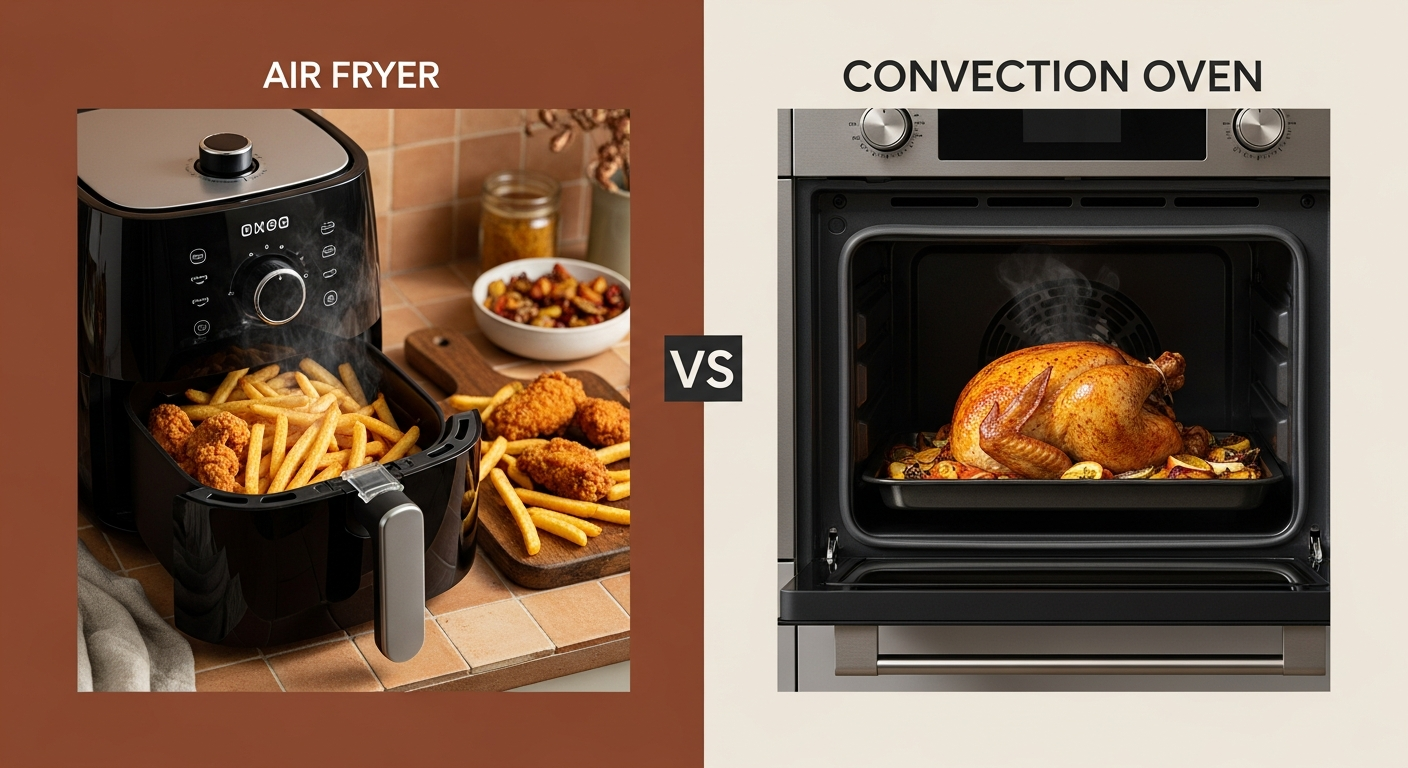
Air Fryer vs. Convection Oven: The Ultimate Kitchen Showdown
The modern kitchen has undergone a radical transformation over the last decade, with technology moving at a pace that rivals the tech industry itself. As we look toward the culinary landscape of 2026, two appliances sit at the center of the “healthy and fast” cooking revolution: the air fryer and the convection oven. For many home cooks and food enthusiasts, the line between these two devices has become increasingly blurred. Are they the same thing in different packages? Can a high-end convection oven truly replace the countertop air fryer that has become a viral sensation?
Choosing between an air fryer and a convection oven isn’t just about counter space; it’s about how you approach meal prep, your dietary goals, and your energy consumption habits. Whether you are upgrading your kitchen suite or looking for a standalone gadget to make weeknight dinners easier, understanding the nuanced differences in airflow, heat distribution, and capacity is essential. In this comprehensive guide, we will break down the mechanics, the pros and cons, and the ultimate performance metrics of air fryers versus convection ovens.
The Science of Hot Air: How Both Appliances Cook
At their core, both air fryers and convection ovens rely on the same fundamental principle of physics: convection. In traditional thermal ovens, heat radiates from the top or bottom, often resulting in “hot spots” and uneven cooking. Convection cooking solves this by using internal fans to circulate hot air around the food. This movement of air strips away the “boundary layer” of cool air that naturally surrounds food, allowing for faster heat transfer and more even browning.
However, the execution of this principle differs significantly between the two appliances. A convection oven is typically a large, box-style unit with a fan located at the back. It moves air at a moderate pace to ensure that multi-rack baking—like three sheets of cookies at once—yields uniform results.
In contrast, an air fryer is essentially a “high-velocity” convection machine. Because the cooking chamber is much smaller, the fan is proportionally much larger and more powerful. This creates a “tornado” effect of hot air. The air fryer’s heating element is also positioned closer to the food, usually directly above it. This intense, concentrated airflow mimics the effects of deep-frying by rapidly evaporating surface moisture, triggering the Maillard reaction (the chemical process that creates browned, flavorful crusts) much faster than a standard oven ever could.
Size, Capacity, and Kitchen Real Estate
One of the most immediate factors in the air fryer vs. convection oven debate is the physical footprint. Convection ovens generally come in two forms: full-sized ranges (or wall ovens) and countertop toaster-oven style models. A full-sized convection oven offers massive capacity, often 5 to 6 cubic feet, allowing you to roast a 20-pound turkey, bake multiple loaves of bread, or prepare a full sheet-pan dinner for a family of six.
Air fryers, meanwhile, are designed for compactness. Most basket-style air fryers range from 3 to 8 quarts. While this makes them ideal for small households, couples, or teenagers looking for a quick snack, they often require cooking in batches if you are feeding a larger group. Attempting to overcrowd an air fryer basket is the fastest way to ruin your meal; if the air cannot circulate between the French fries, they will come out soggy rather than crisp.
As we move into 2026, we are seeing a rise in “hybrid” appliances. Many manufacturers are now producing large-capacity toaster ovens that feature a dedicated “Air Fry” mode, which ramps up the fan speed to bridge the gap between the two technologies. If counter space is a premium but you want the benefits of both, these multi-functional units are becoming the gold standard for modern food enthusiasts.
The Need for Speed: Cooking Times and Preheating
In the fast-paced world of modern cooking, speed is often the deciding factor. This is where the air fryer truly shines. Because of its small internal volume, an air fryer requires little to no preheating time. You can go from a cold machine to 400°F (200°C) in less than three minutes. Furthermore, the high-velocity air cooks food roughly 20% to 30% faster than a convection oven. For example, a tray of frozen chicken wings that might take 35 minutes in a convection oven can be perfectly crispy in an air fryer in just 15 to 18 minutes.
Convection ovens, particularly full-sized ones, require a significant lead time. Heating up a large cavity to a stable temperature can take 10 to 20 minutes depending on the model. While convection settings do speed up the actual cooking process compared to “standard” baking, they cannot compete with the sheer velocity of an air fryer.
However, the “speed” advantage of the air fryer is negated if you have to cook in multiple batches. If you are preparing dinner for a party of eight, the convection oven’s ability to cook everything at once makes it the more efficient choice in terms of total time spent in the kitchen.
Texture and Taste: The Battle for the Perfect Crunch
For food enthusiasts, the ultimate test is the sensory experience. The air fryer has earned its “fryer” moniker because it is unparalleled at creating a crunchy, fried-like texture with only a fraction of the oil. It is the king of frozen foods, chicken wings, Brussels sprouts, and tofu. The intense heat allows the exterior to crisp up while keeping the interior moist, creating a contrast that is difficult to achieve in a large oven without overcooking the center.
Convection ovens, on the other hand, are the masters of “gentle” evenness. They are superior for baking delicate items like soufflés, cakes, and artisanal breads where a violent blast of air might cause the batter to lean or the crust to harden too quickly. Convection ovens are also better for roasting large proteins. A whole roast beef or a prime rib benefits from the more cavernous space of a convection oven, which allows the heat to surround the meat without scorching the outer fat layer before the center reaches the desired temperature.
If your primary goal is to replicate the taste of a pub-style appetizer at home, the air fryer is your best friend. If your passion lies in complex baking and large-scale roasting, the convection oven remains the superior tool.
Energy Efficiency and Operational Costs
With rising utility costs and a growing focus on sustainability heading into 2026, energy efficiency is a major consideration for the home cook. The air fryer is significantly more energy-efficient for small to medium tasks. Because it is smaller and cooks faster, it uses less total kilowatt-hours than a large oven. Additionally, using an air fryer in the summer doesn’t heat up your entire kitchen, reducing the load on your air conditioning system.
A full-sized convection oven requires a massive amount of energy to heat up the entire cavity, even if you are only cooking a single potato. However, if you are using the oven to its full capacity—utilizing all three racks to meal prep for the week—the energy cost per pound of food becomes much more competitive.
For the average user who is simply reheating leftovers or making a quick lunch, the air fryer is the clear winner for the wallet. It is estimated that using an air fryer instead of a conventional oven can save the average household between $30 and $80 a year on electricity, depending on usage frequency and local rates.
Versatility: Beyond Just Frying and Roasting
When we look at the versatility of these machines, the convection oven has traditionally held the crown. A high-quality convection oven can bake, roast, broil, and sometimes even proof bread or dehydrate fruit. Its large size accommodates various cookware, from heavy Dutch ovens to delicate glass pie plates.
However, air fryers have evolved. By 2026, the market is flooded with air fryers that offer specialized functions like “Dehydrate,” “Reheat,” “Bake,” and even “Slow Cook.” Some high-end models come with rotisserie spits for whole chickens.
The main limitation for the air fryer remains the type of cookware you can use. Most air fryers are limited to their own baskets or very small, heat-safe dishes. You cannot fit a standard 9×13-inch casserole dish into most air fryers. This limits their use for lasagna, large bakes, or sheet-pan meals. Conversely, the convection oven’s versatility is only limited by your imagination and the size of your pans.
FAQ: Common Questions for Home Cooks
**1. Can I use my convection oven as an air fryer?**
Yes, but with caveats. To get “air fry” results in a convection oven, you should use a perforated tray or a wire rack set over a baking sheet. This allows the air to reach the bottom of the food. You may also need to increase the temperature by about 25 degrees or cook for slightly longer since the airflow isn’t as concentrated as in a dedicated air fryer.
**2. Is air fried food actually healthier?**
Generally, yes. Air frying uses up to 80% less oil than traditional deep-frying while providing a similar texture. Compared to a convection oven, the health benefits are similar if you use the same amount of oil, but the air fryer’s design often encourages “dripping” where excess fats fall through the basket, away from the food.
**3. Do I need to buy special pans for a convection oven?**
While you can use standard pans, low-sided pans are better for convection cooking. High-sided pans can block the airflow, preventing the convection fan from doing its job efficiently. For the best results, use light-colored aluminum sheets rather than dark or non-stick pans, which can cause over-browning in a convection environment.
**4. Can you bake a cake in an air fryer?**
You certainly can! However, because the heat is so intense and the fan is so close, you usually need to lower the temperature by 25-50 degrees compared to a standard recipe and check it much earlier. Small, dense cakes like lava cakes or muffins work best in an air fryer.
**5. Which appliance is easier to clean?**
This is a toss-up. Air fryer baskets are usually dishwasher safe, but they can accumulate stubborn grease in the nooks and crannies. Convection ovens often have a self-cleaning cycle, but cleaning the racks and the glass door by hand can be a chore. Overall, the air fryer is usually quicker for daily “wipe-and-go” cleaning.
Conclusion: Which One Deserves a Place in Your Kitchen?
As we navigate the culinary trends of 2026, the choice between an air fryer and a convection oven ultimately comes down to your lifestyle and the size of your household. For the busy professional, the student, or the health-conscious snacker, the **air fryer** is an indispensable tool. Its speed, ability to create crunch without oil, and energy efficiency make it a powerhouse for daily, small-scale cooking.
However, for the serious home baker, the holiday host, or the large family, the **convection oven** remains the gold standard. It offers a level of capacity and delicate heat control that a small, high-velocity basket simply cannot match.
If you have the budget and the space, many modern food enthusiasts are finding that the best solution is a “middle ground” appliance—the countertop convection toaster oven with a dedicated air fry setting. This hybrid approach gives you the best of both worlds: the massive airflow needed for perfect fries and the interior volume needed for a small roast or a tray of cookies. Whichever you choose, both appliances represent a significant step forward in making high-quality, delicious food more accessible than ever before.