

















The Ultimate Sustainable Seafood Shopping Guide 2026: How to Eat Better for the Ocean
In 2026, the modern home cook is more connected to the source of their food than ever before. We no longer just ask, “Is this fish fresh?” Instead, we ask, “How was this caught? Who caught it? And what will the ocean look like tomorrow because of this purchase?” As we navigate a global food system transformed by climate shifts and technological breakthroughs, sustainable seafood has moved from a niche luxury to a culinary necessity. Our oceans are under pressure, yet they remain a resilient source of life-giving protein if managed with care. This 2026 guide is designed for food enthusiasts who refuse to compromise on flavor or ethics. Whether you are searing scallops or simmering a bouillabaisse, understanding the state of our seas is the first step toward a better meal. In the following sections, we will explore the labels that matter, the rise of restorative aquaculture, and the smart swaps that will define your kitchen this year.
1. Decoding Labels and Certifications in 2026
The landscape of seafood labeling has evolved significantly. In 2026, the blue Marine Stewardship Council (MSC) and green Aquaculture Stewardship Council (ASC) logos remain the gold standards for wild-caught and farmed fish, respectively. However, the “alphabet soup” of certifications has become more streamlined and transparent through digital integration.
When you walk into a market in 2026, look for the **”Climate-Resilient”** badge, a newer certification that identifies fisheries using adaptive management to protect stocks migrating due to warming waters. Furthermore, the **Fair Trade Certified** seal has become increasingly common in the seafood aisle, ensuring that the human beings behind your tuna steak were treated with dignity and paid a living wage.
For the home cook, the most important development is the **QR-Code Traceability** system. By 2026, most premium retailers provide a scannable code on the packaging. A quick scan reveals the vessel’s name, the specific gear used (such as pole-and-line vs. longline), and the exact landing port. If a product lacks this level of transparency, it’s a signal to ask your fishmonger more questions or choose an alternative.
2. The Rise of Regenerative Aquaculture: Beyond “Farmed”
For years, “farmed fish” was a dirty word in many culinary circles. But as we move through 2026, the narrative has shifted toward **Regenerative Aquaculture**. This isn’t just about minimizing harm; it’s about seafood that actually improves the environment.
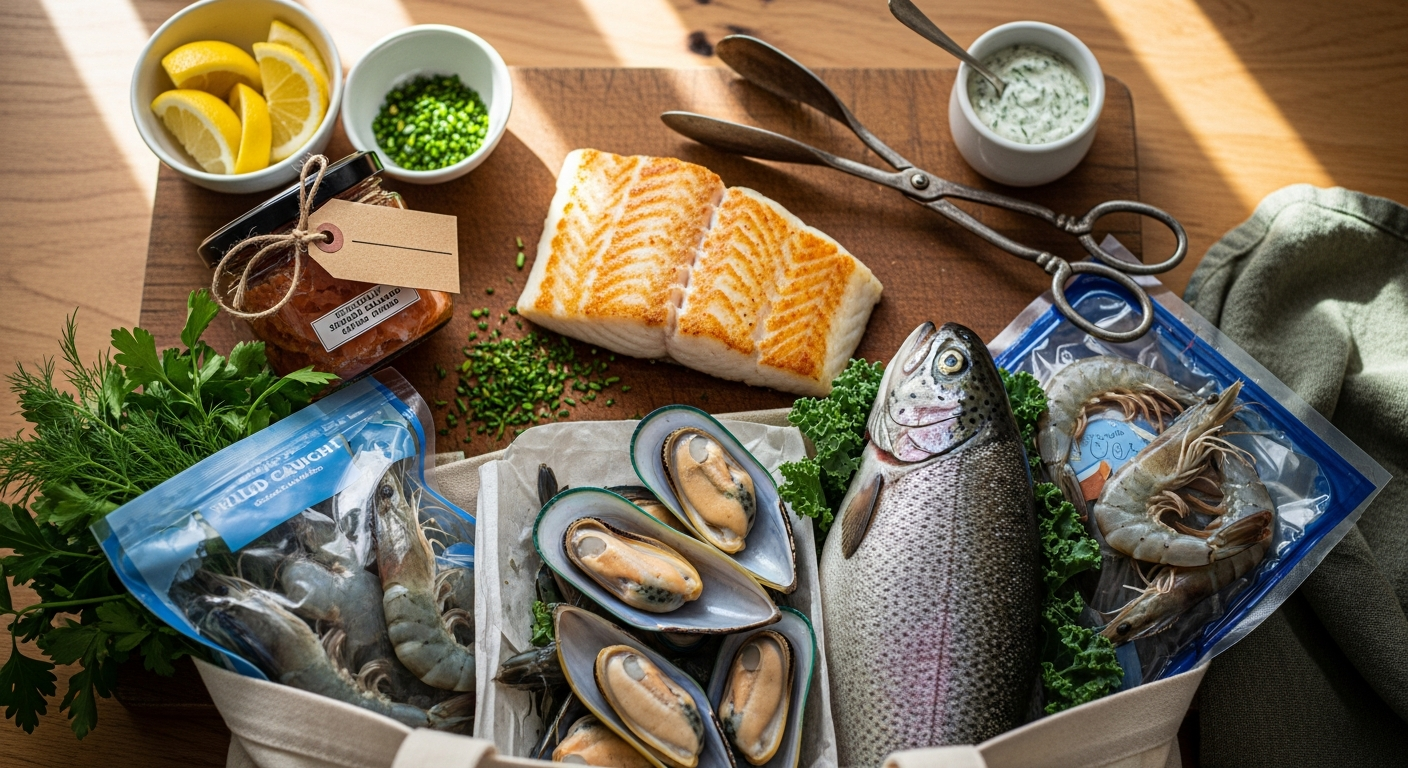
The stars of this movement are bivalves and sea vegetables. Mussels, clams, and oysters are “zero-input” proteins. They don’t require feed; instead, they filter the water, removing excess nitrogen and carbon. In 2026, bivalves are the ultimate “guilt-free” luxury.
Furthermore, **Kelp and Seaweed** have transitioned from garnish to main ingredient. Rich in umami and minerals, these “forests of the sea” provide habitat for other species and sequester massive amounts of carbon. When shopping this year, look for brands that specialize in polyculture—where fish, shellfish, and seaweed are grown together in a self-sustaining ecosystem. This holistic approach represents the pinnacle of seafood sustainability in 2026.
3. Smart Swaps: Culinary Alternatives for 2026
Sustainable cooking often requires a willingness to experiment. Many of our traditional favorites, like Bluefin tuna or certain wild-caught shrimps, face continued pressure. In 2026, the savvy home cook looks for “underloved” species that offer similar textures and flavors with a fraction of the environmental impact.
* **Swap Tuna for Farmed Amberjack (Kanpachi):** High-quality, land-based recirculating aquaculture systems (RAS) now produce Amberjack that rivals the fattiness and clean flavor of premium tuna, without the mercury concerns or overfishing risks.
* **Swap Atlantic Salmon for Arctic Char:** While sustainable salmon options exist, Arctic Char is often a safer bet. It has a similar flaky texture and high Omega-3 content but is typically farmed in closed-containment systems that protect wild populations.
* **Swap Imported Shrimp for US-Farmed RAS Shrimp:** By 2026, land-based shrimp farms have popped up across the country. These “interior” shrimp farms use biofloc technology to recycle water and eliminate the need for the antibiotics or habitat destruction often associated with coastal shrimp ponds in other regions.
* **Embrace “Invasive Deliciousness”:** Look for Lionfish or Blue Catfish. In 2026, eating invasive species is a badge of honor for eco-conscious chefs. These species disrupt local ecosystems, and by eating them, you are helping to restore balance to the water.
4. The Digital Fishmonger: Technology at the Counter
The year 2026 marks the era of the “High-Tech Hook-to-Cook” pipeline. For the home cook, technology has bridged the gap between the ocean and the kitchen.
Blockchain technology now secures the supply chain, making it nearly impossible for “seafood fraud”—the practice of mislabeling cheaper fish as premium species—to occur. If you are buying “Wild Alaskan Halibut” in 2026, the blockchain record ensures it isn’t actually a cheaper flatfish from elsewhere.
Additionally, AI-driven apps have replaced static “red-light/green-light” lists. These apps now provide real-time updates based on current seasonal biomass and sudden environmental changes (like an unexpected algae bloom or a sudden surge in a specific population). Before you head to the store, a quick check of your preferred seafood rating app will give you a localized recommendation of what is “peaking” in terms of both flavor and sustainability that week.
5. Seasonality and the Carbon Footprint of Seafood
One of the most significant shifts in 2026 is the recognition that “sustainable” also means “low carbon.” A fish caught sustainably but flown halfway around the world in a temperature-controlled jet carries a heavy environmental price.
To shop sustainably in 2026, you must embrace **Seafood Seasonality**. Just as you look for tomatoes in August, you should look for Dungeness crab or wild salmon during their specific harvest windows. Buying in season often means the fish can be transported via sea or road rather than air, drastically reducing its carbon footprint.
Furthermore, don’t snub the freezer aisle. In 2026, “Flash-Frozen at Sea” technology has reached a point where the quality is indistinguishable from fresh-caught. Frozen seafood allows for more efficient transport and significantly reduces food waste—a major pillar of sustainability. By choosing frozen, you allow the supply chain to move at a pace that favors the planet rather than the clock.
6. The Ethics of the Industry: Social Sustainability
As we look at the seafood landscape in 2026, we realize that sustainability isn’t just about the fish; it’s about the people. The “Social” in ESG (Environmental, Social, and Governance) has become a primary focus for food enthusiasts.
The seafood industry has historically struggled with labor abuses on the high seas. However, in 2026, consumer demand has forced a change. When shopping, look for companies that participate in the **Global Dialogue on Seafood Traceability (GDST)**. These companies commit to radical transparency regarding their labor practices.
Supporting **Community Supported Fisheries (CSFs)** is another excellent way to ensure ethical shopping. Much like a CSA for vegetables, a CSF connects you directly with local fishers. This model ensures that the majority of your dollar goes directly to the person on the boat, supporting local economies and traditional fishing communities that prioritize long-term ocean health over short-term industrial profit.
FAQ: Navigating the Seafood Aisle in 2026
**Q: Is “Wild-Caught” always better than “Farmed”?**
**A:** Not necessarily. In 2026, many wild stocks are overfished, while advanced aquaculture (like RAS or regenerative seaweed/shellfish farms) can be more sustainable. The key is *how* and *where* the fish was raised or caught, rather than the category itself.
**Q: How can I tell if my seafood contains high levels of mercury?**
**A:** As a general rule in 2026, “eat lower on the food chain.” Smaller fish like sardines, anchovies, and mackerel have much lower mercury levels than apex predators like shark, swordfish, or large tuna. Most modern traceability apps also now include average mercury data for specific regions.
**Q: Is canned seafood a sustainable choice?**
**A:** Absolutely. Canned (or tinned) seafood is experiencing a culinary renaissance in 2026. It has a long shelf life, reduces waste, and often features smaller, more resilient species. Look for “pole-and-line caught” labels on canned tuna and mackerel.
**Q: Why is sustainable seafood often more expensive?**
**A:** Sustainable seafood reflects the “true cost” of food. It accounts for fair wages, careful harvesting methods, and environmental protections. While the price tag may be higher than industrial-grade fish, the quality, flavor, and peace of mind are significantly greater. In 2026, we view seafood as a high-quality protein to be savored, not a cheap commodity.
**Q: What is the most sustainable fish I can buy right now?**
**A:** While it varies by region, farmed bivalves (mussels, oysters, clams) and seaweed are universally considered the most sustainable options in 2026, as they provide ecosystem services while they grow.
Conclusion: The Future is in Your Kitchen
Shopping for seafood in 2026 is an act of advocacy. Every time you choose a regeneratively farmed oyster over a questionably sourced shrimp, or a local seasonal catch over an imported luxury, you are sending a signal to the global market. The “Sustainable Seafood Shopping Guide 2026” isn’t just about a list of fish to avoid; it’s about a new philosophy of eating—one that celebrates transparency, embraces technological innovation, and respects the delicate rhythms of our oceans.
As home cooks, we have more power than we realize. By demanding traceability, supporting ethical fishmongers, and expanding our palates to include invasive or underloved species, we ensure that the bounty of the sea remains available for generations to come. The next time you stand at the fish counter, remember: you aren’t just buying dinner; you are participating in the restoration of our blue planet. Happy cooking!